

Providing Expert Advice
For the Home Gardener
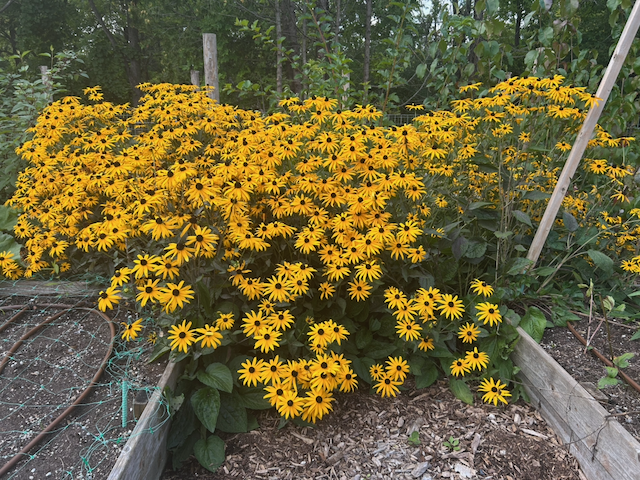
“Fall has always been my favorite season. The time when everything bursts with its last beauty, as if nature had been saving up all year for the grand finale.”
Notes from my Garden - October
"As I write this month's blog, outside my window, the leaves are falling like a most colourful rain. The shades of yellow, gold, orange and red are very much the grand finale Lauren talks about!
However, I'm not sure Fall is my favourite season. In fact, I don't think I have one. Each season has it's own unique charms and appeal as well as it's sad moments.
Thank you to all who attended our plant sale last month. It was such fun to see the Meaford Pavilion overflowing with plants and people. We appreciate your support. Hopefully, those who bought plants have been able to get them in the garden! Just a reminder to keep watering any new plants until the frost.
Weeding is important in the fall as well. In the last 2 weeks, I've been busy edging my garden beds and I'm currently about halfway through! While I did this task in the spring, the plants have grown so much that they are overflowing onto the lawn. This of course means that the grass around the beds isn't cut, the weeds have easier access, and the beds look messy and uncared for. In some of my beds, I have had to “edge” (think dig!) more than 12 inches to provide enough room for the mower to do its job. As I'm edging, I'm also weeding and assessing what needs to be moved so a slowish process. However, the finished beds look wonderful and have much clearer definition. When finished, I'll move a few things, add some additional mulch and be ready for winter and spring! I don't cut back my perennials until spring unless they are diseased. Edging is one of the tasks that is a good fall project. I'll keep working on it!
The harvest continues! I need to bring in the rest of the tender veggies (tomatoes, zucchini, beans, and peppers). The cabbage, carrots, leeks, kale and chard should be fine until there is a hard frost. I have to pick my squash as well - lots of butternut and spaghetti squash, a few pie pumpkins (they didn't do well) and a few Sugar Baby Watermelon that are quite small. I'm still harvesting herbs for the winter which I'll freeze or dry. Most of the apples have been picked however, the Anjou pears are still ripening off. I'm spending more time in the kitchen processing now! Last winter, I left my Chicago Hardy fig planted outside and it looked dead this spring. However, once cut back, it sprang to life a few weeks later and is now 4 ft tall and wide with lots of little figs. I don't expect them to ripen this year as they started late however, the squirrels will likely enjoy them!
Also on the harvest list is gathering seeds from some plants. I had beautiful 6 foot tall white hollyhocks this year and will want to start those seeds in the spring.
After Thanksgiving, I usually plant my garlic, though this depends on the weather. if it's too wet, it's hard to make decent sized holes and get the cloves set in firmly. I hate planting in the snow! Once planted, I cover the beds with straw, cross my fingers for a cold enough winter, and wait until spring!
A reminder, our Gardener in Residence program is continuing this month at libraries in Owen Sound, Meaford, Thornbury and Durham. Please check us out if you have time! Wishing everyone a wonderful Thanksgiving. May we all be grateful for our ability to garden, grow and nurture! Happy Gardening!
Susan Cox
Group Coordinator
Grey County Master Gardeners
Part of an international non-profit community service network, Grey County Master Gardeners is a group of approximately 20 trained horticulturists who volunteer their time to provide advice to home gardeners in the Grey and Bruce area. This is accomplished by providing info to the public in various forms, including in person or virtual, through presentations, clinics and workshops, or through written work such as articles, posts, blogs or social media.
All Master Gardeners have successfully completed university horticultural studies and must meet ongoing continuing education requirements to make sure that our advice to gardeners is based on current horticultural knowledge.
There are over 25 local Master Gardener groups in Ontario, focusing on sustainable gardening information for the public. There are also Master Gardener groups in many provinces, most states and in some international locations. More information about the Provincial organization can be found at (MGOI – Motivating and Inspiring Gardeners in Ontario).
Not in Grey County? Don’t despair. You can find your local MG groups, including Toronto, Guelph, Collingwood and others, at www.mgoi.ca.
-
Established in 1996, Grey County Master Gardeners are part of the province-wide Master Gardeners of Ontario (MGOI). Grey County Master Gardeners are trained volunteers who offer non-biased, science-based horticultural information and advice to home gardeners and community groups in both Grey and Bruce Counties.
Our Vision
An Eco-Responsible focus in the garden
Our Values
We believe in the importance of having an eco-responsible focus when gardening. This means we encourage gardening practices that enhance biodiversity, mitigate against climate change, are healthy for the environment and support human health. As a group, we prefer consensus whenever possible, however there are times when a majority rules. We value inclusiveness, collaboration, engagement of community and cooperation.
